Method · 22 min read
Flashcards and Adaptive Review: Remember to Use, Not Just to Guess
Words, context, and active recall: how to transform flashcards into a journey toward real conversation.
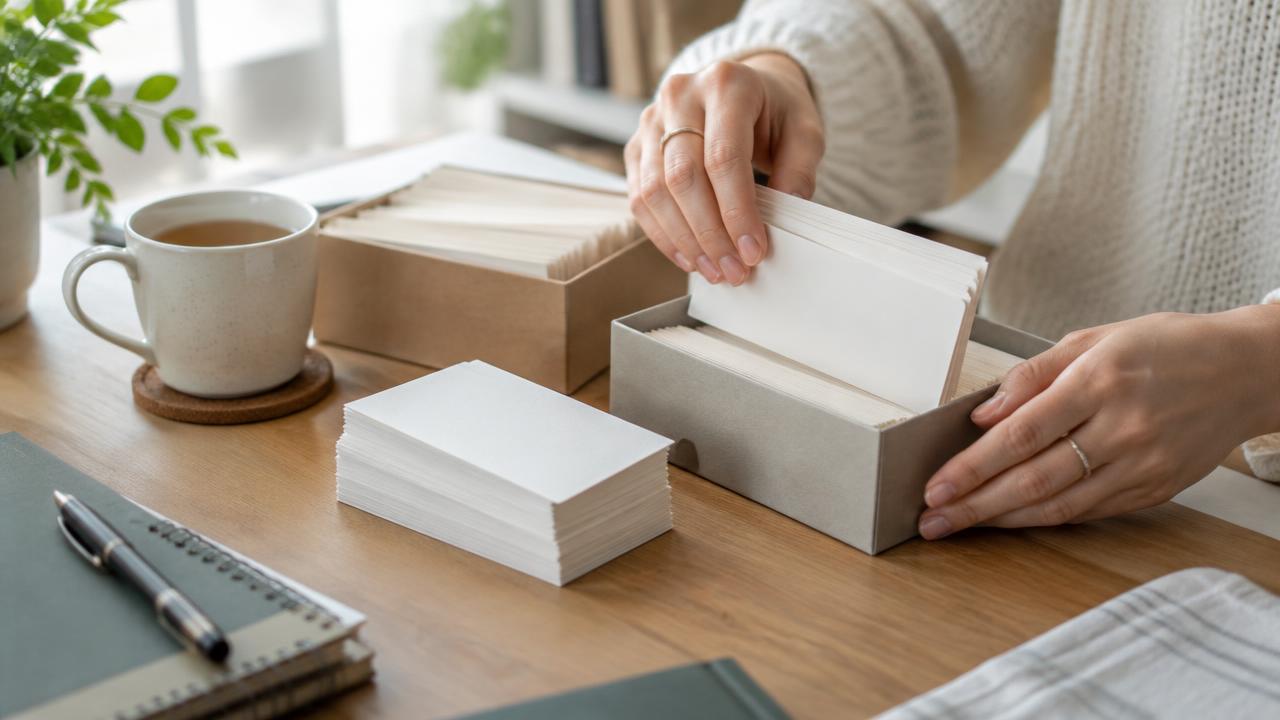
The starting point: focusing on what you can actually use
A flashcard can help you recall a word, a structure, or a short expression. However, its value is not measured by the number of correct answers on your screen. If you recognize the translation of "biglietto" but cannot ask for a ticket for tomorrow, you have practiced only a portion of the skill, not the full communicative task. The goal of a useful learning path is to build a bridge between what you remember and what you might actually want to say. This is why it is better to start with concrete situations rather than accumulating vocabulary without a clear destination.
Imagine, as a hypothetical scenario, that you are preparing for a trip to Spain. A card with "billete" on the front and "ticket" on the back can help fix the initial meaning. A card that presents the situation "Ask for a ticket for tomorrow," however, leads you toward a response like "Quisiera un billete para mañana." The second activity also requires a grammatical choice and an intention. It does not make the first one useless; it completes it and reveals the steps that separate recognizing a word from constructing a request.
In this article, adaptive review is considered a way to orient your practice toward specific difficulties as they emerge, rather than a guarantee of learning. The process moves from choosing cards to active recall, then to spaced sessions and transferring those skills to conversation. The criterion remains practical: after your review, can you retrieve the expression without seeing it, adapt it sensibly, and use it when the question changes? This test is worth more than a sequence of cards completed without hesitation.
Choosing Your Content: Focus on Intentions, Not Just Lists
To build a manageable set of flashcards, start by choosing a specific situation and then identify the communication goals within it. At a train station, for example, you might want to ask for a schedule, buy a ticket, state a destination, or double-check information. You don't need to add every single object found in a station right away. Focusing on what you actually want to do makes it easier to decide which words deserve attention and which can wait. This also prevents your deck from becoming a dry inventory that feels disconnected from your daily life.
A helpful exercise is to write down, in English, four things you would want to say in a hypothetical situation. For a hotel booking, these might be: booking a room, specifying dates, asking if breakfast is included, and mentioning a special request. Then, pick just one of these and find a natural expression in your target language, checking its meaning and structure. In Spanish, "¿Está incluido el desayuno?" allows you to ask if breakfast is included. This way, the card is born from a clear need, rather than a vague desire to memorize random words.
Evaluate every new item with three questions: will I use this in a likely situation? Do I understand the sentence well enough to adapt it? Can I verify that the example is correct? If you can't answer yes to these, simplify the card or set it aside for now. This doesn't mean only studying travel phrases: the same rule applies to talking about habits, expressing preferences, or describing a problem. While your priorities will shift along with your goals, the selection principle remains the same: every card should have a clear reason for being in your review session.
Creating clear flashcards without giving away the answers
An effective card provides a specific enough prompt to allow for a genuine attempt at recall. If the front only says "to take," you could be thinking of taking a train, taking an object, or taking a decision. This isn't a true test of memory; it is just an ambiguous question. It is better to provide context, such as "How do you ask for a ticket to Madrid in Spanish?" On the back, you can put "Quisiera un billete para Madrid," along with a brief note clarifying the function of the request.
Reduce the cognitive load when a card tries to achieve too many things at once. A long sentence featuring a new verb, two unfamiliar words, and a grammatical structure you haven't studied yet makes it hard to pinpoint why you got it wrong. You can separate vocabulary recall from sentence construction while keeping an example that links them. Conversely, a card that is too guided might give the answer away through an initial letter, a nearly complete sentence, or an immediately visible translation. These supports aren't always useless, but they change the difficulty of the test and you need to be aware of them.
Try this practical exercise: take a card you often get wrong and describe exactly what it is supposed to be testing. If the goal is to remember "para" to indicate destination in this phrase, the front could be "Complete: Quisiera un billete ... Madrid." If you want to practice the entire request, remove the fill in the blank sentence and simply describe the situation. These two cards perform different tasks. One checks a specific choice, while the other requires broader production. Keeping them distinct allows you to better interpret both mistakes and successes, without giving a guided answer the same weight as a sentence you built from scratch.
Active Recall: Attempting an Answer Before Flipping the Card
The decisive moment of study happens before you flip the card. Read the prompt, try to retrieve the answer, and only then check the back. If you flip it immediately and think you know it, you are mostly experiencing a sense of familiarity. This can be pleasant and helpful for a first encounter, but it is not the same as retrieving information without assistance. To make the difference clear, say the answer out loud, write it down, or formulate it completely in your mind before comparing it with the example.
Imagine a scenario where the front of the card asks you how to say where the station is. Try to say ¿Dónde está la estación? and then check the form. If you only remembered estación, note that you recalled the noun but not the question. If you produced the complete phrase with some hesitation, do not discount the success: distinguish correct retrieval from speed. However, if you only recognized the solution after reading it, consider another round of independent recall necessary.
Do not turn the attempt into a long test of endurance. When nothing comes to mind, look at the solution, try to understand the missing step, and revisit the item later. After checking, you can cover the back again and reconstruct the sentence, but keep in mind that this immediate recall benefits from the exposure you just had. The most valuable test will come in a separate session. An honest self-assessment distinguishes between at least three conditions: independent response, partial response, and recognition after help. This distinction provides more actionable information than a generic 'I knew it', especially when deciding which cards to simplify or study further.
Correcting errors without memorizing a single 'right' answer
The back of a flashcard should provide a reliable reference, but it does not always represent the only acceptable answer. When asked how to order a coffee in Spanish, both "Un café, por favor" and "Quisiera un café, por favor" are valid ways to phrase it. If the card is designed to practice "quisiera" specifically, only the second one meets that goal. If the goal is simply to place a polite order, both are relevant. Before judging your response, clarify whether you are testing a specific grammatical form or your general ability to express an intention.
When you make a mistake, separate the meaning from the form. Did you ask for something different than what was intended? Did you choose the right vocabulary word but get the agreement wrong? Did you leave out an essential part? For example, in "Quisiera dos billetes para mañana," the plural "billetes" must match "dos." Answering with the singular "billete" signals a specific, isolated problem, not necessarily that the entire expression has been forgotten. Correcting that specific point and testing a different quantity is more helpful than mechanically repeating the phrase ten times.
A useful exercise is to reconstruct the correct answer, briefly explain the error in English, and produce a variation. After practicing "dos billetes," you can move to "un billete" to observe how the number changes. If you do not know why a solution is correct, avoid making up a rule based on a single example; consult a grammar guide or a reliable linguistic source. Even examples generated by digital tutors require attention, as they can contain errors. Reviewing becomes more effective when your check is used to understand what to change, rather than just marking an answer as right or wrong.
Spacing your sessions: the value of review over time
Reviewing in separate sessions allows you to test your recall when the answer is no longer supported just by a recent reading. The 2022 meta-analysis by Kim and Webb on the effects of distributed practice in second languages reports the benefits of this study structure. The reference is available at https://doi.org/10.1111/lang.12479. However, these results are derived from specific study groups and conditions: they do not prove that a particular app feature will produce the same effect for every person, content type, or goal.
On a practical level, you can spread a small group of flashcards over several days instead of cramming everything into a single session. There is no need for a calendar that acts as a universal formula. The useful gap between attempts also depends on how new the material is, how the card is constructed, and what you are actually able to retrieve. If you find only blank answers, you might need to reduce the load or go back to understanding the example. If everything is instant, you can try a less guided prompt.
Consider this editorial suggestion: introduce a few expressions, revisit them on a later day, and check further down the line if you can use them without the original hint. The exact days can be adapted to your availability. The important thing is not to mistake three consecutive repetitions for three independent memory checks. When you miss a session, start back up by observing what you truly remember, without trying to catch up on everything through a rushed accumulation. Spacing works as a way to organize your work: it creates opportunities for recall and monitoring, but it is no substitute for the quality of your cards, the understanding of sentences, or communicative practice.
What to adjust: difficulty, context, and level of support
Talking about adaptive review shouldn't just mean waiting for a system to show you a flashcard again. From a study perspective, adapting means responding to observed difficulties by changing something relevant: the workload, the context, the amount of support, or the type of exercise. If you can't remember a word, it can be helpful to go back to its example sentence. If the word comes to mind immediately but you don't know how to use it in a sentence, continuing to ask for just the translation risks practicing only what you already know how to do.
Take a request like Quisiera una mesa para dos, to ask for a table for two. If you forget mesa, you can temporarily isolate the vocabulary word while keeping the restaurant context. If you struggle with the structure of the request, work on Quisiera… with words you already know. If you can recall the whole sentence but can't answer ¿Para cuántas personas?, a different step is needed: connecting the question to the answer Para dos personas. The difficulty doesn't necessarily belong to the card itself; it can emerge when the task changes.
A sensible workflow is to observe, identify the weak point, change a single variable, and test it again. If you increase speed, length, and new vocabulary all at once, you won't understand which change caused the problem. Reducing support also requires a gradual approach: first an incomplete sentence, then a described situation, and finally a question without a translation. These are study suggestions, not the description of a specific algorithm. The principle to keep in mind is that adaptation should produce a more relevant exercise, not simply a higher volume of identical repetitions.
Varying sentences to check your understanding
A memorized phrase can serve as a solid starting point, but it becomes unreliable if it only works in its original form. To test your comprehension, change one element at a time: the destination, the date, the quantity, or the person. From "Quisiera un billete para Madrid" you can move to "Quisiera un billete para Valencia" and then to "Quisiera dos billetes para Valencia." Changing the city is mostly a matter of vocabulary; switching to two tickets also requires managing plural forms. Not all variations carry the same weight.
Try a quick guided exercise. Start with "Quisiera un billete para mañana." First, ask for two tickets for tomorrow: "Quisiera dos billetes para mañana." Then go back to one ticket and change the day: "Quisiera un billete para hoy." Finally, cover the examples and respond to the prompt: Ask for two tickets for today. The expected solution is "Quisiera dos billetes para hoy." This final step combines changes you have already practiced separately, making it clear whether you can reconstruct the sentence or are simply repeating the last version you saw.
However, variation does not mean you can swap any word into any structure. Languages have common combinations, specific prepositional requirements, and grammatical constraints that must be checked. When a transformation requires a construction you haven't studied yet, stop and look for an explanation instead of automatically extending the pattern. You can also alternate between cards with specific answers and more open prompts, such as: Make a polite request at a bar. In open requests, checking your answer must consider appropriateness and meaning, not just a literal match with the back of the card. This specific shift is what prepares you to move from your study deck to real communication.
Listening and pronunciation: adding voice without mixing up your practice
Reading a sentence, recognizing it when you hear it, and pronouncing it yourself are related activities, but they are not the same thing. If a written flashcard feels easy, you cannot automatically assume you will understand that same expression when it is part of a spoken question. Similarly, being able to repeat a phrase after hearing a model does not prove you can recall it spontaneously. It is better to separate your goals: one attempt to remember the content, a listening phase to observe the sounds, and a separate chance to produce the sentence without reading it.
You can try this approach: recall a short expression from your card, check the text, listen to an available audio model, and repeat it. Then, hide the text and return to the starting prompt. To practice listening comprehension as well, use a related question, such as ¿Para cuándo quiere el billete?, and try to answer Para mañana. In this exercise, the response is short, but it requires you to understand that you are being asked about the timing of the trip. If you struggle, identify whether the issue is understanding the question or recalling the necessary expression.
The text-to-speech feature on your phone can help with listening, but it is not a reliable way to evaluate your pronunciation. Even a simple comparison between your voice and a model is not enough to determine for certain how understandable you are in a real conversation. Avoid giving listening activities diagnostic weight they do not actually have. In Linguademy, all voice features require a connection and service availability: keep this in mind when organizing your study session. If you cannot use voice features at a particular moment, you can still focus on written work and save the oral practice for later.
From flashcards to conversation: building a simple exchange
The transition to real conversation begins when you no longer know exactly which phrase you are about to produce. A flashcard tends to present an isolated task; a dialogue, however, requires you to interpret incoming information and choose a relevant response. To bridge this gap, start with a brief exchange using familiar content. In a hypothetical ticket office scenario, you might need to specify a destination, a day, and the number of people. There is no need to introduce complex complications right away: simply changing the order of the questions is enough to make retrieval less dependent on a memorized sequence.
Here is a guided exercise. Prepare three pieces of information: Madrid, tomorrow, two people. Respond without checking your cards to ¿Adónde quiere viajar?, ¿Para cuándo quiere los billetes? and ¿Cuántos billetes necesita? Possible answers are A Madrid, Para mañana and Dos billetes, por favor. Next, try to combine the information into Quisiera dos billetes para Madrid para mañana. The repetition of para is acceptable because it introduces two different pieces of information; if you prefer, you can spread the request across several turns instead of trying to force a long sentence every time.
For the final check, change one piece of information or the order of the questions. If you get stuck, do not necessarily go back to the entire deck: identify the specific missing link. You might know mañana but not understand para cuándo, or perhaps you understand the question but cannot retrieve billetes. This diagnosis makes your next review session more targeted. One important limit remains: a prepared dialogue does not replicate the full variety of a real conversation, with its varying speeds, alternative phrasings, and the need for clarification. It is a useful intermediate step precisely because it reduces certain difficulties, rather than a definitive demonstration of communicative mastery.
Connecting Practice, Coursework, and Assignments in Linguademy
In Linguademy, the Practice section contains your flashcards, the Coursework covers grammar and quizzes, and Assignments stores your personalized activities. Adaptive flashcards adjust based on your current level and recent challenges; instructors can also present them during a session. This overview details the available features, though it does not imply specific calculation methods, timing intervals, or undocumented automation. For learners, the goal is to identify which area to use when a hurdle arises, rather than treating every mistake as a simple need for more repetition.
Imagine a hypothetical scenario: you remember the word billete, but repeatedly get the plural form wrong in requests. Practice helps you recall the term; Coursework is where you go for grammar and quizzes; and personalized tasks are found in Assignments. During a lesson, you can mention the difficulty and try out a question, an example, and your own response. This link between memory, explanation, and exercise is a suggested way to use the platform, not a guarantee that every error automatically triggers a specific sequence of actions.
The Linguademy instructor is digital, not human, and can make mistakes. It speaks in the language you are studying; explanations in your native language are only available in writing. Keep this in mind when preparing a question: you can practice the request orally in your target language and consult a written explanation in English. If a correction seems inconsistent, verify it before adding it permanently to your cards. The goal is not to finish as many screens as possible, but to use insights from your review to choose your next step. A difficult card should be a clue about what you need to learn, not just another item to see again.
A week of study: a practical and sustainable plan
The following schedule is a suggested guide, not a strictly tested protocol or a guarantee of results. Choose a specific scenario, such as ordering at a café, and prepare a small group of verified expressions. You might include "Un café, por favor," "Quisiera un té," "¿Cuánto cuesta?" and "La cuenta, por favor." On the first day, clarify the meaning and usage of each phrase, create clear prompts for yourself, and try to recall the answers before looking at the solutions. Avoid adding more material just because the first session feels easy.
On a later day, revisit your cards without reading through the whole deck first. Note which answers come to mind naturally, which are partial, and which require checking the back. Then, dedicate another session to variations: swap in a different drink you already know, change the quantity once you feel confident, and alternate between a direct request and a phrasing using "quisiera." For listening practice, use available audio models and separate the task of understanding the question from the task of producing an answer. If a step introduces too much new grammar, lower the difficulty rather than expanding the set further.
Toward the end of the week, try a short exchange without cards. In a hypothetical scenario, someone asks you "¿Qué desea?" and you place an order; then you ask for the price and the check. Take note of what is missing: a specific word, the sentence structure, understanding the question, or recalling the phrase without hints. In the final review, only modify the cards related to these specific struggles. If you have fewer days available, spread this same process over a longer period. The success of the experiment is measured not just by how many phrases you remember, but by how accurately you can identify your next useful exercise.
Tracking progress and recognizing the limits of flashcards
To gauge your progress, observe how you handle similar tasks at different times. Ask yourself if you can recall a phrase without help, if you maintain the meaning when changing a detail, and if you can answer a related question. There is no need to turn every session into a complex assessment; consistent notes are enough. A correct answer achieved after seeing the back of a card is different from an independent recall. Likewise, producing a phrase on its own is not the same as managing a conversation with unexpected questions.
A helpful check involves revisiting a practiced situation using a different prompt. If you first practiced "Chiedi un tavolo per due" and later encounter "¿Para cuántas personas?", you can verify if the expression is accessible through multiple paths. Maintain a distinction between guided practice and open-ended activities. If performance seems to slip, consider the difficulty of the new task: do not automatically blame every hesitation on memory loss. Greater independence often involves managing more choices, so keep your comparisons fair.
Flashcards have clear limits. A specific deck alone cannot cover listening to long speeches, managing conversation flow, adjusting register, or clarifying a misunderstanding. It can prepare useful components for these activities, but they must then be practiced in real contexts. Remembering many translations does not represent your entire language proficiency. Any references to A1-C2 levels in Linguademy are approximate and do not constitute a certification. Use your card results as data on specific content, rather than a final judgment on everything you can do in the language.
Choosing your path based on tools, time, and access
To choose the best way to study with flashcards, start with your real-world constraints. Do you primarily need to memorize vocabulary, reconstruct sentences, or link your review to speaking? Do you have short, regular sessions or longer, less frequent ones? Physical cards allow you to organize cues and responses manually, while a digital path should be evaluated based on its documented features. There is no need to assume one tool is always superior. What matters is how well you can select material, attempt recall, check the answer, and transfer that knowledge to a less structured task.
At Linguademy, you can use the course, quizzes, assignments, and flashcards for free. For speaking lessons, we offer Pro: $19.99 per month or $119.88 per year, including a 7-day trial and 60 minutes per month. Note that this does not include infinite voice usage. If your main goal is to test expressions in conversation, consider this minute total before organizing your schedule. You can prepare difficult points in writing beforehand to arrive at speaking practice with relevant questions and examples, rather than expecting preparation to replace the exchange itself.
Additionally, consider your connection. All voice features require network access and service availability. Offline use applies only to the basic Spanish course and materials already saved: it does not extend to all languages or all activities. In a hypothetical study scenario during a commute with an unstable connection, check which materials are available first and save the speaking portion for a suitable time. The sustainable choice is the one that fits your actual conditions, not one built around assumed possibilities.
FAQ: Volume, Translation, Difficult Cards, and Moving Toward Speaking
How many cards should I study? There is no one-size-fits-all number: choose a quantity that allows you to genuinely attempt the answers and check your mistakes, rather than just flipping cards automatically to finish. If your review backlog takes up your entire session, temporarily reduce new additions. Should I remove the English translation? Not necessarily. It can clarify meaning and provide an initial prompt. To test your progress, gradually pair cards with situations, questions in your target language, and prompts that do not always rely on the same English phrasing.
What should I do with a card I keep getting wrong? First, check if it is ambiguous, too long, or built on an explanation you did not understand. Then, identify the hurdle and simplify the task. Repeating an unclear card more often does not automatically solve the problem. Can I count an answer as correct if it differs from the back? Yes, if it correctly expresses the intent and the card does not require a specific form; when in doubt, verify the variant. However, do not mistake a plausible answer for a definitely correct one just because it looks like the example.
When can I stop reviewing a phrase? If you can retrieve it in separate sessions and use it with sensible variations, you can give it less attention and focus on elements that are still fragile, scheduling checks for later. Are flashcards enough to start speaking? They can help you prepare words and structures, but you also need to understand questions and choose responses during an actual exchange. If I know the written phrase but do not understand it by ear, do I have to start from scratch? No: separate listening practice from retrieval work. The goal remains the same: remembering in order to express something, not just guessing which answer is hidden on the back.